A Turkish court has convicted Şebnem Korur Fincancı, the president of the Turkish Medical Association and a renowned human rights activist, of disseminating “terrorist propaganda” in a trial seen by government critics as an attempt to silence dissent, Agence France-Presse reports.
Turkey last year adopted a new media law requiring jail terms of up to three years for disseminating false information about Turkish security that would trigger “fear and disturb public order”, the BBC adds:
The Turkish justice system has also drawn ire from some Western countries. The US said that it remained gravely concerned by the continued judicial harassment of civil society, media, political and business leaders” in Turkey following the life sentence given to prominent philanthropist and campaigner Usman Kavala last April.
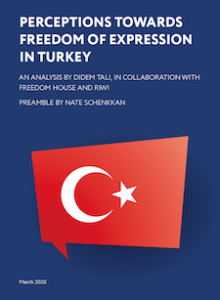 The most important of the year’s coming election will unquestionably take place on June 18, when President Recep Tayyip Erdogan seeks to stretch his rule over Turkey into a third decade. The outcome will shape geopolitical and economic calculations in Washington and Moscow, as well as capitals across Europe, the Middle East, Central Asia and Africa,
  While Erdoğan’s grip on Turkey and hard-nosed political tactics “make him the playmaker in this election,” İmamoğlu had “passed the stress test”,
 ‘Increasing authoritarian practices’
How resilient are Turkey’s democratic institutions, though, as it turns 100? Qantara.de asks:
Under the leadership of Recep Tayyip Erdoğan, Turkey has increasingly turned its face from the West toward the East. It has associated itself more with Islamic values, made new friends and allies in the Arab world and built up its overseas military involvement, including in Somalia and Qatar, where Turkey’s presence has been welcome. These developments have not made all Turks happy, however, as all this has been accompanied by rising authoritarianism.
 “Turkey today is a prime example of increasing authoritarian practices,” notes Sinem Adar, an expert on Turkey at the Center for Applied Turkey Studies (CATS) in Berlin. “Since the late 2000s, the country has steadily moved away from the rule of law and effective separation of powers.”
“Given the country’s almost seven decades of experience with competitive multi-party elections and its integration into the Western institutional architecture, the demise of Turkish democracy is arguably one of the most disappointing examples of a global trend,” she says.
Ideology, identity, and interest
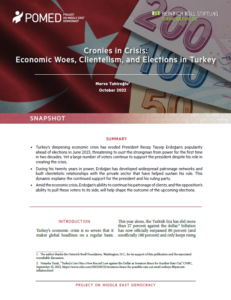
Over the last twenty years, Erdoğan and his ruling Justice and Development Party (AKP) have developed widespread partisan patronage networks across Turkey and built clientelistic relationships with the private sector, according to Merve Tahiroğlu, the Turkey Program Director at the Project on Middle East Democracy (POMED).

Merve Tahiroğlu. Credit: POMED
Clients of the Erdoğan regime, poor and rich, will play an important role in the upcoming elections. Although the economic crisis appears to be stripping away a significant number of voters from the ruling bloc, millions remain loyal to the AKP out of ideology, identity, and self-interest, she observes in Cronies in Crisis: Economic Woes, Clientelism, and Elections in Turkey, a joint POMED-Boell Foundation analysis. If the Turkish opposition is to pull these voters to its side, it will need to do more than convince them of Erdoğan’s culpability in the crisis and their own ability to stop the meltdown.
2023 is destined to be a critical year both for Turkey and Turkey–EU relations, according to Çiğdem Nas, the secretary-general of the Economic Development Foundation in Istanbul, the leading think-tank dedicated to Turkish–EU relations.
“If the opposition wins, they will mostly concentrate on a return to the parliamentary regime, and this process will also entail a democratisation agenda. Under such a scenario, we may expect a revitalisation of Turkey’s EU perspective,” she says.
*The NGOs submitting the third-party intervention to the Constitutional Court are: ARTICLE 19, the Association of Lawyers for Liberty (ÖHD), the European Association of Lawyers for Democracy and Human Rights (ELDH), European Democratic Lawyers (AED), the Human Rights Association (İHD), Human Rights Watch (HRW), the International Commission of Jurists (ICJ), the International Federation for Human Rights (FIDH), Rights Initiative Association, and the Turkey Human Rights Litigation Support Project (TLSP).
Political ban is ‘axe to democracy’, says Turkish opposition leader https://t.co/jv8O71u867
— Democracy Digest (@demdigest) January 11, 2023


