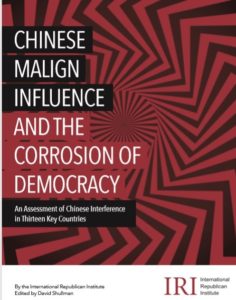
 The United States is reshaping how it uses foreign aid in order to compete with China. The executive branch and Congress are exploring efforts — some controversial and still few on details — to better leverage foreign aid as a tool to prevail in an era of great power competition, according to Patrick Quirk and David Shullman, respectively, senior director of the International Republican Institute’s Center for Global Impact and senior advisor at IRI and an adjunct senior fellow at the Center for a New American Security (CNAS):
Recent research from the International Republican Institute [a core partner of the National Endowment for Democracy] confirms that China is exploiting — and exacerbating — democratic weaknesses in target states to advance its interests. …..Further, the Chinese Communist Party (CCP) regularly co-opts local civic groups or journalists to stymie negative portrayals of its engagement and thereby protect growing investments and ties to corrupt elites in target countries. At a macro level, China is projecting its authoritarian model as a viable alternative to the West’s liberal democratic variant.
 Regardless of the final contours of policy changes under consideration, it is clear that the United States should make democracy assistance a central component of its strategy for prevailing against China. This should involve using foreign aid to help make countries more resilient to CCP coercion and, hand in hand with diplomacy, champion the superiority of U.S. liberal democracy to China’s authoritarian option. To chart this path forward, the United States can look to the past for effective democracy assistance approaches. Two examples stand out, they write for The Hill:
- First, from Ukraine to Zimbabwe, U.S. foreign aid programs have strengthened the capacity of civil society actors to uncover corruption, increase transparency and hold leaders accountable. Similar programs could serve as a check against China’s malign influence if the United States deploys them in countries vulnerable to CCP coercion. It must tailor support to equip recipients with the resources necessary to uncover and publicize opaque deals between their leaders and Beijing.
- Second, U.S.-funded trainings can enhance foreign journalists’ understanding of critical journalism skills and inculcate a belief in them that reporters play a critical watchdog role in society. If the United States expands and targets these programs in countries vulnerable to Chinese coercion, they could help increase transparency as a check against opaque BRI deals and the associated expansion of CCP influence.


