Credit: FreedomHouse
United States intelligence agencies have assessed that Chinese operatives helped push disinformation about #Covid-19 messages across platforms, according to six American officials, who spoke on the condition of anonymity to publicly discuss intelligence matters, the Times reports:
 The amplification techniques are alarming to officials because the disinformation showed up as texts on many Americans’ cellphones, a tactic that several of the officials said they had not seen before. That has spurred agencies to look at new ways in which China, Russia and other nations are using a range of platforms to spread disinformation during the pandemic, they said….Their broader warnings about China’s spread of disinformation are supported by recent findings from outside bipartisan research groups, including the Alliance for Securing Democracy and the Center for a New American Security, which is expected to release a report on the topic next month.
“What we’ve seen is the C.C.P. mobilizing its global messaging apparatus, which includes state media as well as Chinese diplomats, to push out selected and localized versions of the same overarching false narratives,” Lea Gabrielle, coordinator of the Global Engagement Center in the State Department, said in late March, referring to the Chinese Communist Party.
The Chinese Communist Party’s party’s expanding global objectives rest on Beijing hopes that its “global network of partnerships centered on China would replace the U.S. system of treaty alliances, the international community would regard Beijing’s authoritarian governance model as a superior alternative to Western electoral democracy, and the world would credit the Communist Party of China for developing a new path to peace, prosperity, and modernity that other countries can follow.”
 Analyst Liza Tobin’s conclusions highlight the urgent need for all democratic countries to comprehend the full scope and scale of China’s interference abroad, to understand why interference occurs and establish general principles in the search for solutions, writes China Analyst at the German Marshall Fund.
In a new report, Friends and Enemies: A Framework for Understanding Chinese Political Interference in Democratic Countries, he identifies five components, which often interact with one another, that together characterize China’s political interference in democracies, he adds:
- Weaponizing China’s economy: Party leaders generate political compliance in foreign societies by communicating the benefits of cooperation, alongside the costs that Beijing can impose upon countries, companies, or individuals who step out of line.
- Asserting narrative dominance: In the global conversation on China, the party manipulates and controls information to downplay and crowd out adversarial narratives and advance those that serve its interests.
- Relying on elite intermediaries: The party relies on intermediaries abroad to shape foreign perceptions of China, often adopting many of the same ambiguous, opaque, and misleading methods that it utilizes to co-opt elites at home.
- Instrumentalizing the Chinese diaspora: The party identifies valuable diaspora members and groups in an effort to penetrate and co-opt Chinese diaspora communities.
- Embedding authoritarian control: The party’s way of doing business, and its efforts to demonstrate a viable alternative to liberal democracy, both strengthen authoritarian norms beyond China’s borders.
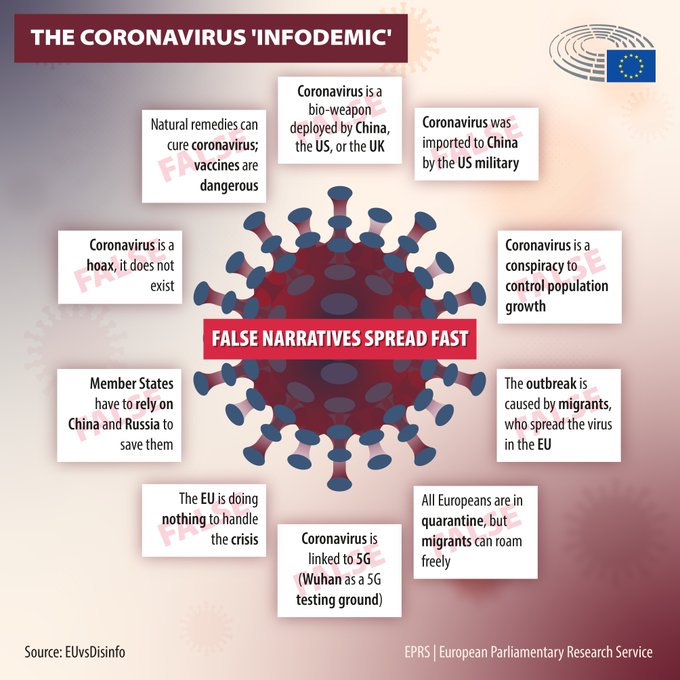
The European Parliament Research Service explains how foreign powers are using the #coronavirus crisis to increase their influence in Europe (image below).
The National Endowment for Democracy’s Christopher Walker and Jennifer Ludwig have described the application of this approach in foreign countries as “sharp power,” which is often conducted through initiatives in the spheres of media, culture, think tanks, and academia,